Evaluating Fishland: A Practical Guide to Using a Quirky Display Typeface
Choosing the right typography for a design project is rarely about finding the "best" font in a vacuum. It is about finding the typeface that best communicates the intended message, tone, and audience of a specific piece of work. Among the vast array of display fonts available today, Fishland has carved out a distinct niche by combining bold, thick letterforms with a friendly, quirky personality. This article provides a detailed evaluation of Fishland, exploring its visual characteristics, ideal use cases, limitations, and how it compares to broader categories of display typography.
Visual Characteristics and Design Identity
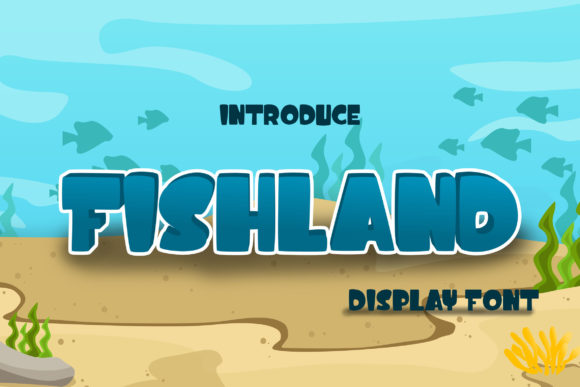
Fishland is classified as a display font, meaning it is designed to be used at large sizes rather than for body text. Its defining characteristic is its weight; the letters are thick, substantial, and assertive. However, unlike many heavy sans-serif or slab-serif fonts that can feel rigid, industrial, or serious, Fishland softens this heaviness through rounded edges and playful proportions. The result is a typeface that feels approachable and whimsical without sacrificing readability at headline scales.
The "quirky" nature of the font comes from subtle irregularities in the stroke widths and the organic shaping of the characters. These details prevent the text from looking machine-generated or sterile. Instead, it evokes a hand-drawn sensibility while maintaining the consistency required for professional digital design. For designers working on projects that need to convey joy, creativity, or lightheartedness, Fishland offers a ready-made emotional connection that standard geometric sans-serifs often lack.
- Weight: Consistently thick and bold, providing strong visual impact.
- Tone: Friendly, inviting, and slightly humorous.
- Style: Rounded terminals and organic curves soften the heavy structure.
Ideal Use Cases for Fishland
Understanding where a font fits is crucial for effective design. Fishland excels in contexts where immediate engagement and a sense of fun are prioritized over formal authority. Below are several scenarios where this typeface proves particularly effective.
Children’s Media and Education
One of the strongest applications for Fishland is in materials aimed at children. Whether designing covers for early reader books, packaging for educational toys, or assets for mobile games, the font’s playful shape aligns naturally with content meant for young audiences. It signals accessibility and fun, helping to lower the barrier to entry for learning or play. Because the letters are thick and clear, they remain legible even when scaled down slightly or viewed on low-resolution screens, which is common in gaming environments.
Brand Identity for Creative Industries
Brands that operate in creative sectors—such as independent book publishers, boutique toy stores, or artistic collectives—often struggle to balance professionalism with personality. Fishland offers a solution by providing a brand name treatment that feels established yet unpretentious. When used for logo construction or primary branding elements, it helps communicate that the company values creativity and human connection. It is less suitable for corporate finance or legal services, where trust is built through seriousness and tradition.
Posters and Event Marketing
In the realm of print and digital advertising, attention spans are short. A poster for a community festival, a children’s theater production, or a quirky art exhibition needs to grab attention instantly. Fishland’s high x-height and bold presence ensure that headlines are readable from a distance. The font’s inherent charm adds an element of intrigue, encouraging viewers to stop and read the supporting details. It works well for quotes and pull-quotes as well, adding visual interest to social media graphics or blog headers.
Comparing Fishland to Alternative Approaches
When evaluating Fishland, it is helpful to consider how it stacks up against other typographic strategies. Decision-making in design often involves choosing between different levels of formality and structural rigidity.
Display Fonts vs. Serif Body Text
A common mistake among novice designers is attempting to use display fonts like Fishland for paragraphs of text. While Fishland is highly legible at large sizes, its thick strokes and quirky details become fatiguing to read in long-form content. In contrast, serif fonts (like Garamond or Merriweather) or clean sans-serifs (like Helvetica or Open Sans) are optimized for reading endurance. The tradeoff here is clarity versus character. If the goal is to inform, use a neutral font. If the goal is to attract attention, use Fishland. They serve complementary roles rather than competing ones.
Rounded Sans-Serifs vs. Quirky Displays
Fishland shares some DNA with rounded sans-serif fonts like Comic Neue or Varela Round. Both styles aim for friendliness. However, there is a key distinction. Rounded sans-serifs tend to be more uniform and predictable, making them safer for general UI design or app interfaces. Fishland, being a display font, is more expressive and stylized. It has more "personality" but less versatility. Choosing between them depends on whether you need a font that blends into the background (rounded sans) or one that stands out as a focal point (Fishland).
Handwritten Scripts vs. Stylized Prints
Another alternative is using handwritten or script fonts to achieve a personal touch. Scripts can feel more authentic and human, but they often suffer from poor legibility, especially when written in all caps or used for titles. Fishland offers a middle ground: it looks hand-crafted and warm but retains the structural integrity of a printed typeface. This makes it a more reliable choice for titles where clarity is still required, whereas scripts might require careful pairing with a simple sans-serif for secondary information.
Limitations and Considerations
No single typeface is a universal solution. Recognizing the limitations of Fishland is just as important as understanding its strengths. Designers must consider the following factors before committing to this font for a project.
- Legibility at Small Sizes: Due to its thick letterforms, Fishland can become muddy or illegible when scaled below 18–24 points. It should not be used for footnotes, captions, or dense informational text.
- Niche Appeal: The quirky nature of the font may clash with minimalist or high-end luxury aesthetics. Brands aiming for sleek, sophisticated, or austere vibes will likely find Fishland too casual or distracting.
- Pairing Challenges: Because Fishland is visually dominant, it requires careful balancing. Pairing it with another busy or decorative font can create visual chaos. It typically pairs best with simple, neutral sans-serifs or clean serifs that allow the display font to take center stage.
Decision Factors for Implementation
To determine if Fishland is the right tool for your next project, ask yourself a few strategic questions. First, what is the primary emotion you want to evoke? If the answer is joy, curiosity, or comfort, Fishland is a strong candidate. Second, who is the audience? If the target demographic includes children, families, or creatives, the font’s style resonates well. Third, where will the text appear? If it is for billboards, website headers, book covers, or game interfaces, the font’s display qualities will shine. If it is for terms and conditions, user manuals, or data dashboards, look elsewhere.
Ultimately, Fishland is a specialized tool in the designer’s kit. It is not a replacement for versatile system fonts, nor is it a substitute for elegant editorial typefaces. However, for projects that require a touch of beauty, humor, and bold visibility, it offers a unique combination of weight and warmth that is difficult to replicate. By understanding its distinct character and respecting its limitations, designers can leverage Fishland to create memorable, engaging visual communications that stand out in a crowded digital landscape.